Daylight-Aware Tee Time Finder
Finds after-work tee times you can actually finish before dark. It ranks by holes completed rather than by tee time, because drive time is paid twice: once in the car, and once in the daylight you no longer have.
I build things with AI: some to learn, some to earn, some for fun.
Cambridge, MA Sony Sports · Hawk-Eye Sc.M. Brown
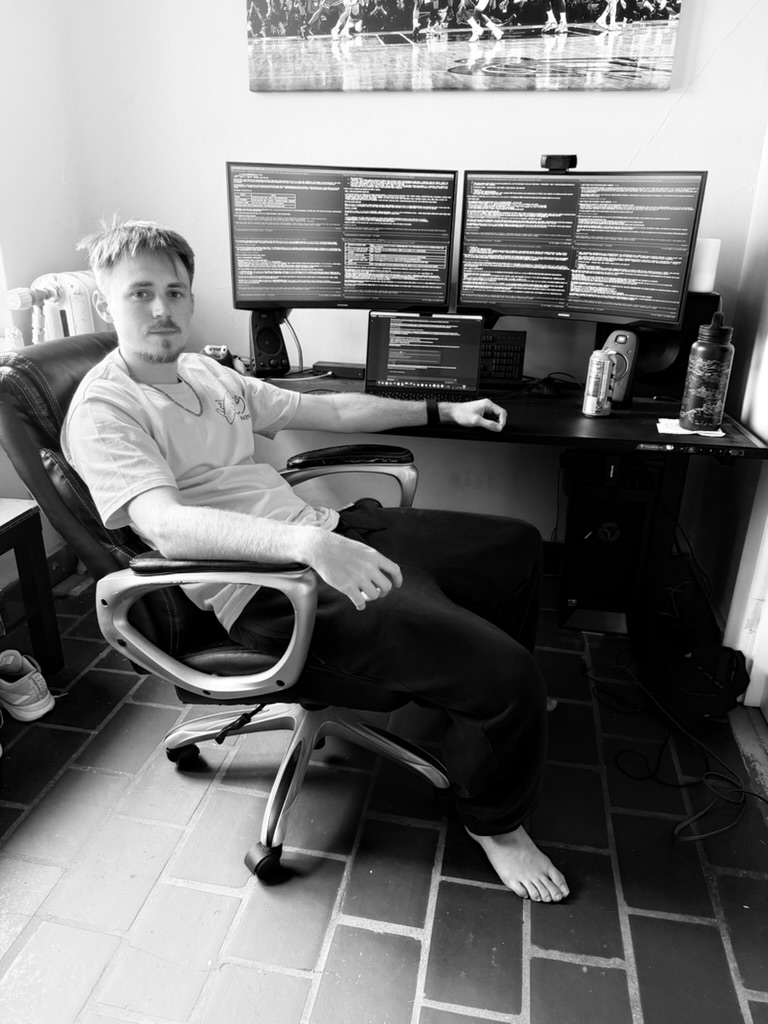
By day I lead NBA player-tracking deployments at Sony Sports (Hawk-Eye), rolling out the motion-capture systems that record every game in the league. The rest of the time I build my own systems and keep them running: agent orchestration, an autonomous sales desk, an AI maintenance product, and a personal operating system I open-sourced.
Twelve systems are below, sorted into the three buckets I actually use: research, fun, and entrepreneurial. Every screenshot is running software, every cover is a schematic of the system under it, and three projects have full papers.
The work
Everything I build sorts into research (finding the edge of what these models can do), fun (things I want to exist, built for me and my friends), and entrepreneurial (finding out what strangers will pay for). The covers are not art: each one is a schematic of how that system actually runs, drawn in the same signal palette as my project notebooks.
Where I push on what Claude can actually do: orchestration harnesses, agent teams, and the skills that hold them together. Three versions of one harness, one question (how does one person run many agents?), plus the other thread: autonomous reading with an audience of one. Each system is here because it hit a wall worth writing down.
A local command center that spawns Claude Code sessions into terminal panes and coordinates a seven-role agent team through flat markdown files. No database: every piece of state is human-readable. Built in four weeks across 162 tickets, all of which were dispatched, reviewed and logged by ATLAS itself.
What replaced V1. An Overseer agent writes tickets into lanes; sub-agents work in isolated git worktrees and answer with files: done, question, clarification, issue. No agent talks to another, so the entire state of the system is readable on disk while it runs. Four agents in daily use.
What follows V2: agents specialized as whole units (own model, tools, skills, MCP) rather than by prompt. One notebook page and no code yet, and the open question is written on it in my handwriting.
A daily brief with an audience of exactly one. Each morning an agent read my goals and live project state, scanned a 30-source floor, and shipped at most 800 tool-verified words, publishing nothing at all when nothing changed a decision. Its own 1,369-line operating program was graded nightly by CI.
Built for myself and my friends, because the fastest way to learn these tools is to ship something you genuinely want to use. Every project here has real users I can text.
A personal AI operating system running on my own WHOOP data. Recovery, strain, sleep and habits on one side; goals, streaks and what is due today on the other. It reads across everything it knows about me and writes the day’s playbook. Shipped sixteen days before WHOOP announced similar features.
A co-op RPG where real-life progress raises your character’s stats. Your workouts are the grind, your goals are the quest line, and your friends are in the party with you.
I photographed everything I own. It tagged all 166 items by style, color and occasion, cut them out, and now builds outfits, names the gaps, and watches my shops for sales. Two days, start to finish.
Finds after-work tee times you can actually finish before dark. It ranks by holes completed rather than by tee time, because drive time is paid twice: once in the car, and once in the daylight you no longer have.
Built to answer one question: will a stranger pay? One is live in production, one runs my outbound sales desk every day behind a human gate, one I built to production readiness and then shelved, and one I shipped, grew, and chose to wind down.
Instant quoting and follow-up built into a screen-printing shop’s own website, replacing the call-back-tomorrow quote. The AI reads the request and writes the reply; every dollar comes from the shop’s own deterministic pricing table. The first install is live on a working shop’s site today.
The outbound sales operation of my one-person company: signal generation into one lead database, a three-email sequence with a lifetime cap checked in code, and a call list for the rest. Nothing reaches a person without my written yes in Slack. Rebuilt end to end; it runs headless on a Mac mini and needs me for exactly five things.
An AI maintenance desk for small property managers. A tenant emails about a leak; it ranks the urgency, picks the right vendor from the manager’s own list, drafts the dispatch, chases the scheduling, and logs every decision to an auditable trail. Email-only on purpose.
A career platform routing engineering students into sports technology, and my first end-to-end AI launch. I shipped it, acquired users, and then wound it down. Deciding to stop is its own skill.
Writing
Not retrospectives. Each one is reconstructed from the record the system kept while running (commit logs, ticket files, graded briefs, audit memos), and reports what was only designed, and what the numbers actually were, alongside what worked. The first two download as typeset PDFs; the third releases with the system it describes.
The ATLAS paper: treating AI coding agents as a staffed team rather than a chat window, with work contracts in flat files and one reviewing agent. Ten principles, three generations, and a convergence ledger that records the misses next to the hits.
Design and field notes from Sift. What happens when relevance is computed against one reader instead of curated for an audience, and what happened when an agent’s operating program was governed like a codebase for eighteen days.
The sales-desk report, updated against the rebuilt system so the rules it states are the rules that run. Coming soon.
Contact
Email is the fastest way to reach me. The walkthroughs are the next best thing after the papers, because they show the systems running rather than described.